

Designing a Dental Laboratory That Performs at Every Station
From floor plan to final prosthesis — how thoughtful layout, the right equipment, and disciplined workflow separate world-class labs from the rest.
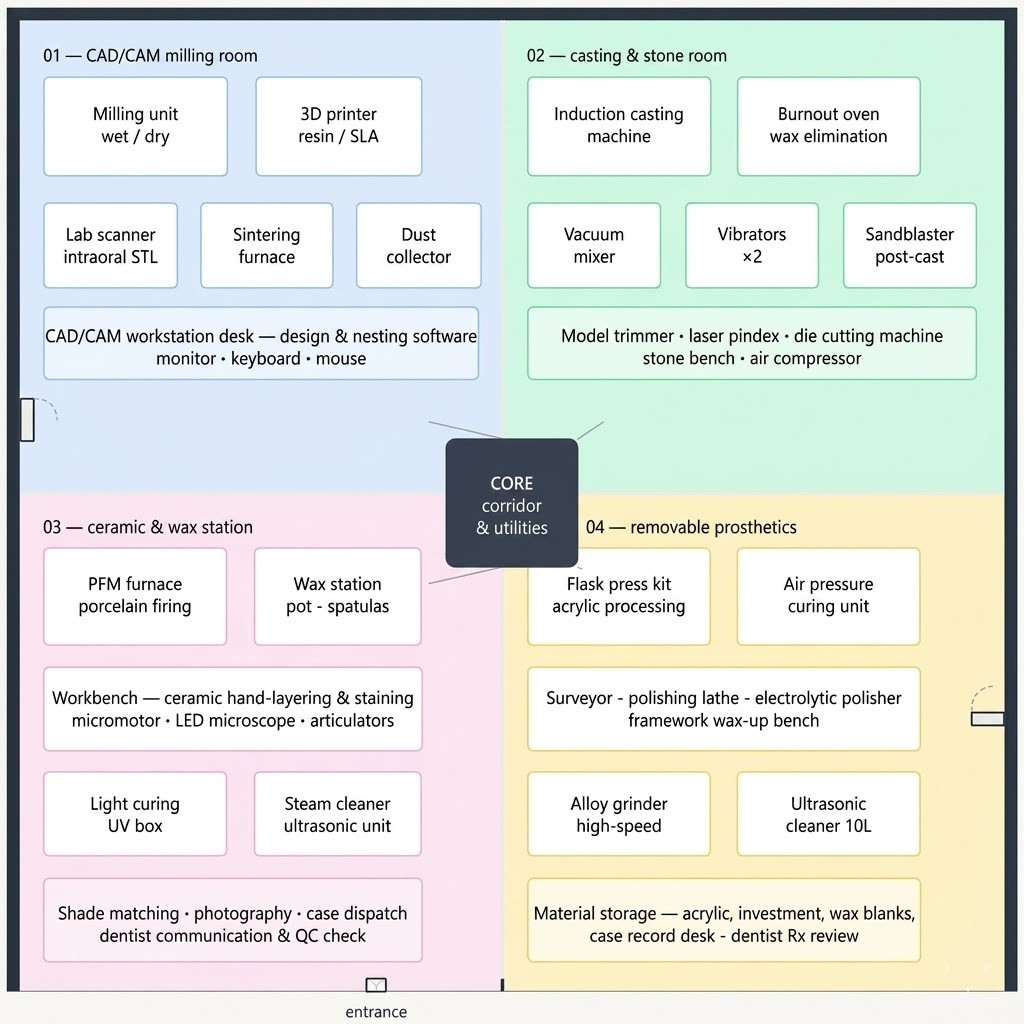
A dental laboratory is not merely a room filled with instruments. It is a precision manufacturing environment where spatial logic, equipment selection, and clinical communication converge to produce prostheses that restore function and aesthetics to real patients. Whether you are commissioning a new facility or reorganising an existing one, the design decisions you make at the outset will determine the efficiency, safety, and commercial viability of every case you accept.
Zoning your laboratory: the foundation of efficient design
The most productive dental labs are planned around distinct functional zones. Contamination risks, dust generation, heat output, and digital versus analogue workflows must all inform how space is allocated. A common high-performing configuration separates the facility into four primary areas:
- Milling Room
Isolated for dust containment. Houses CAD/CAM milling units, 3D printers, sintering furnaces, and lab scanners.
- Stone & Casting Room
Dedicated to investment, burnout, induction casting, PFM firing, and alloy finishing.
- Casting Room
Separate heat-generating processes from general workstations. Ventilation is critical.
- Work Station Area
Wax stations, ceramic benches, CAD/CAM desktops, articulator work, and microscope inspection.
Storage for gypsum, investment, resins, and acrylic materials should be accessible from both the casting and workstation zones, but segregated from clinical outputs. The lab entrance, positioned separately from production areas, defines a clear dirty-to-clean workflow — a non-negotiable in any accredited facility.
“Spatial logic is the first piece of quality assurance. When every technician moves intuitively through the space, errors and cross-contamination drop.”
Sourcing dental lab equipment for every production zone
Equipping a dental laboratory demands category thinking. Each zone carries its own equipment profile, and purchasing decisions should reflect the prosthetic mix your laboratory intends to produce.
The milling room is anchored by a wet/dry CAD/CAM milling unit capable of processing zirconia, PMMA, wax, and composite blocks. Supporting it: a high-resolution 3D lab scanner, a zirconia sintering furnace, a resin 3D printer with a UV curing unit and resin model cleaner, a titanium anodizer for implant components, and a dedicated dust collector and air compressor. These are not optional peripherals — they are the backbone of a digital production line.
The casting room requires a vacuum mixer for bubble-free investment, a burnout furnace, an induction casting machine, and a sandblaster for post-cast surface preparation. Add a PFM porcelain furnace, an electrolytic polisher, a polishing lathe, and an alloy grinder to complete a full metal-ceramic workflow. Model articulation and die work demand a model trimmer, vibrators, a laser pindex system, and a die cutting machine.
The workstation area calls for ergonomic single-unit benches with integrated suction, semi-adjustable articulators, wax pots, survey instruments, micromotors for finishing, and an LED microscope for fine detail verification before dispatch.
The prosthetic range: what a well-equipped lab can fabricate
A fully outfitted dental laboratory can cover the entire spectrum of fixed and removable prosthodontics:
- Lithium disilicate veneers & crowns
- Full-contour zirconia restorations
- Titanium custom abutments
- PFM crowns & bridges
- Acrylic complete dentures
- Cobalt-chrome partial frameworks
- Cast metal partial dentures
- Implant-retained overdentures
Digital workflow: standardised precision at scale
The digital pathway — scan, design, mill or print, sinter, finish — has transformed fixed prosthetic fabrication into a reproducible, traceable process. A digital impression or STL file received from the clinician is scanned or imported, designed in CAD software with defined occlusal parameters, and milled from a pre-tested disc of zirconia or lithium disilicate. Sintering to final density, staining, and glazing complete the restoration. Every stage is logged, verifiable, and repeatable.
This standardisation also accelerates dentist-lab communication. Digital design files can be shared for approval before milling begins, eliminating the most common cause of remakes: unconfirmed occlusal schemes. Shade photographs, digital bite records, and virtual articulation reduce ambiguity at every decision point.
Manual fabrication: the irreplaceable complexity of removable prosthetics
Acrylic complete dentures, cobalt-chrome partial frameworks, and cast skeletal prostheses remain disciplines where the skilled technician’s hands are indispensable. The fabrication sequence — primary impression → study cast → custom tray → final impression → jaw registration → tooth trial → processing → finishing — demands clinical judgment at each stage, not just mechanical execution.
Framework design for a removable partial denture requires analysis on a surveyor, precise rest seat and clasp positioning, and wax-up of major and minor connectors before investing and casting. Acrylic processing in a flask press unit under controlled heat and pressure determines whether a complete denture will distort or remain dimensionally stable. These steps cannot be automated. They are where experienced technicians earn their value.
Communication with the prescribing dentist is equally complex at this level. Shade selection, tooth mould approval at trial, occlusal vertical dimension confirmation, and esthetic review require a structured feedback loop — clear prescription forms, annotated photographs, and in some cases, joint patient consultations. A well-organised laboratory workflow includes these checkpoints as standard.
EQUIPMENT SOURCING
From milling units and sintering furnaces to articulators and casting machines — browse the full range of professional dental lab equipment with fast shipping. Go to Dentsma store.